
TTIA Urges Global Tuna Industry To Put Cooperation Ahead Of Competition
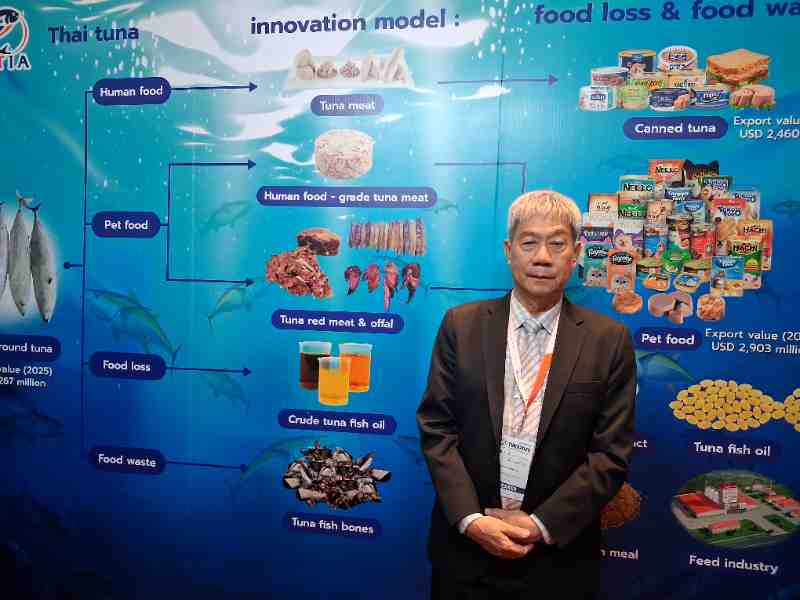
Adison Promthep, Advisor to the Thai Tuna Industry Association (TTIA), voiced concerns over the global geopolitical situation and its impact on Thailand’s tuna trade with international markets. Speaking to Atuna at INFOFISH TUNA 2026, he said navigating these challenges is difficult and urged businesses across the global tuna supply chain to cooperate rather than compete during tough times.
Promthep said global tuna businesses remain heavily reliant on developments in the Middle East, with the repercussions of the crises being felt across Thailand’s tuna industry, the world’s largest tuna processing hub.
“We had thought the war in the Middle East would end soon when it began in late February, but we are still dealing with its repercussions. Our biggest priority is to ensure that the high operating costs we are facing do not reach consumers. This applies not just to the Thai tuna business, but to the global tuna industry.”
The executive highlighted that, as businesses, competition is vital. “But at this turning point, competing is not the most important thing; cooperation is. If we do not help each other, the supply chain could collapse. Fish stocks are healthy in all oceans, but we need to make sure this reaches consumers at a reasonable price, which is important. Efficient operations are the need of the hour.”
Ongoing Geopolitical Turmoil
When Atuna asked about the biggest challenge that the Thai tuna industry is facing now, Promthep said: “Costs are climbing, and global economies are struggling. Businesses must therefore be cautious about where they spend. Consumers, however, still need to buy food and expect canned tuna to remain affordable. For many, it is the cheapest source of healthy protein, meaning we cannot raise prices despite inflation. That is our biggest challenge. We can improve operational efficiency, and it requires a joint effort across the entire tuna supply chain.”
The executive expressed worries about the skyrocketing fuel prices. “Vessels have been raising fish prices, and as processors, we need fish to keep our operations running. This puts us in a difficult position.” Atuna reported this week that the price of skipjack raw material in Bangkok is at an exceptional high of USD 2,200. Promthep said that if it climbs again, the industry will be in deep trouble.
Promthep urged boat owners to make full use of technology to enhance the efficiency of fishing operations and to adopt a model to reduce operating costs. He pushed processors to use 100 percent of a fish and emphasized the relevance of value-added products. “All parts of the tuna must be used, and not only for cans. Fish oil, pet food, and other value-added products have high demand in global markets. At this point, we cannot afford to waste any part of the fish.”
In the first half of the year, amid low WCPO catches, Thai processors have been sourcing large volumes of frozen whole round skipjack from boats operating in the Indian Ocean. Promthep stated that the Thais purchase raw materials from other oceans, and the low catches in the WCPO have not, at this point, impacted processing operations, but are a concern in the coming months.
EU-Thai FTA Concerns
The EU-Thailand Free Trade Agreement (FTA) has been a topic of discussion, with European canners insisting that tuna must not be included in the deal. Earlier this year, the European Commission stated it will take into consideration “economically sensitive sectors such as tuna.” Last year, the TTIA pushed for the deal to be implemented.
Promthep questioned why European canners are concerned about the FTA.“The fishing industry is very much a part of trade deals between governments. If European canners have a problem with tuna being included in it, they should be discussing it with their Commission. The Thai canners or our government never pushed hard for it.”
He also argued that Thai exporters cannot ship huge volumes to the European bloc nor compete with the massive volumes of canned tuna sent to the EU from Ecuador. “We are not going to compete with the massive volumes sent from Ecuador, which already has an FTA with the EU. The transport to countries in the bloc is also going to be expensive for us. Hence, exporting huge volumes to compete with Ecuador is not practical for us.”
Atuna reported earlier this year that the Ecuadorians delivered 164,547 M/T of canned tuna in 2025 to the EU, 35 percent more YoY. Thailand sold 11,782 M/T that year. Thai canned tuna has a 24 percent duty which is expensive for importers.
The European Commission recently extended the current autonomous tariff quotas (ATQs) for tuna and other fishery products and will add sustainability criteria to future ATQs applicable from the first quarter of 2027. Atuna asked for TTIA’s position on this, to which Promthep asserted that Thai canners have not been compromising on sustainability.
“Our loins have been complying with EU regulations, and the Thai government ensures strict checks, especially on whether tuna has come from IUU fishing practices. In the future, we are strengthening monitoring of forced labor on boats. However, we require information from fishing boats flagged to other nations, as the Thai do not have its own fleet and we source from others. Nations to which these boats are flagged must also comply with regulations. We will also speak to workers on carrier vessels that supply fish to Thai ports.”
In 2025, the EU imported 2,927 M/T of frozen pre-cooked loins from Thailand.
Uncertainity Looms
When asked if there is a roadmap for handling the ongoing crisis, including high fuel costs, Promthep opined that businesses must must adapt to changing times. “We are trying to see how to navigate through these troubled times.”
The Donald Trump administration introduced the reciprocal tariffs last year. Thai processors were worried about how it would impact their business in their largest market. Promthep stated that large volumes of tuna were sent to the US before the implementation of the tariff, and the industry is hopeful that the US would cut them down further. Thailand has proposed talks between Prime Minister Anutin Charnvirakul and Trump this week as the two countries seek to conclude negotiations on a bilateral trade deal and discuss tariff rates.
UK Tariff Cut A Positive Move
Amid all the volatility that the Thai tuna sector is undergoing, there was also good news this year. The UK cut its import tariffs on tuna products from several nations, including Thailand, and hence the nation will be able to deliver canned tuna without the 24 percent duty.
Promthep said this is indeed a positive move by the UK government to help ease the cost of living for consumers.
Asked whether Thailand could export large volumes to the UK amid low ocean catches and other challenges, he said the Thai tuna industry was ready to meet demand. However, high transportation costs, driven by elevated fuel prices, remain a challenge.
0 Comments