


Tuna Longliners Continue To Flout WCPFC Rule On At-Sea Transshipments
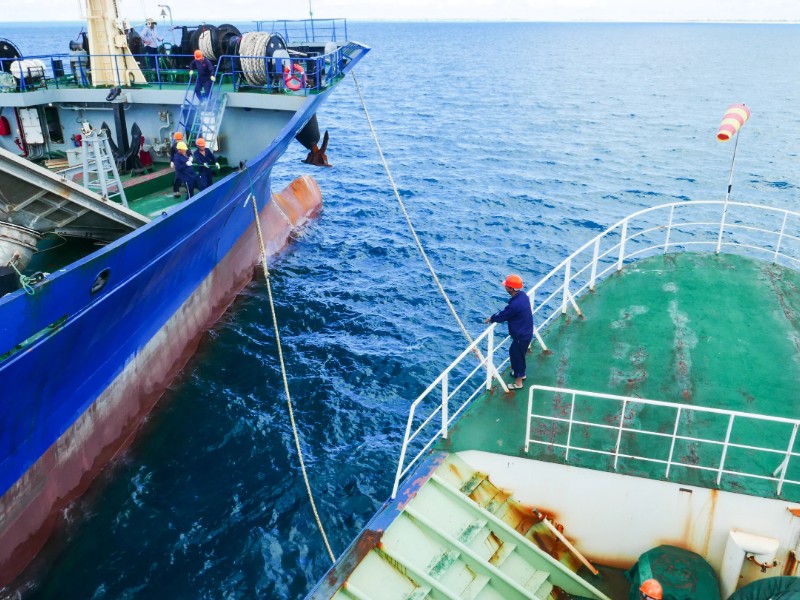
Over 40 percent of tuna longliners and carriers conducting at-sea transshipments in the WCPFC convention area do not qualify under the impracticability exemption of the RFMO, according to a study by the Marshall Islands Marine Resources Authority (MIMRA). Vessel behavior and operational patterns show these boats can transship at the nearest port but are not doing so.
‘High-seas transshipment in the Western and Central Pacific Ocean: Fleet, Structure, Vessel Economics, and the Impracticability Assessment’ report was presented at the Commission’s Technical and Compliance Committee (TCC) meeting in September.
According to the study, at-sea transshipment moves catch from fishing vessel to carrier beyond the reach of port-based monitoring. WCPFC prohibits non-purse seine vessels from transferring catches at sea in its convention area unless in-port transshipment is impractical (the exemption). But vessels such as longliners can do it if they can prove that “transhipment would impose significant economic hardship, and that in-port transhipment would force a significant and substantial change to the vessel’s historical mode of operation.”
The study points out a critical gap that needs to be addressed by the WCPFC. The policy concern is traceability and control: port calls allow authorities to inspect catch, documentation, vessel activity and compliance more effectively, reducing opportunities for IUU-derived tuna to enter supply chains. Purse seiners operating in the WCPO must transship at port. Large longliners can apply
Two years ago, the first iteration of the report by the MIMRA, with research by Starboard Maritime Intelligence, was presented at the TCC meeting. The paper found repeated port avoidance by many longliners licensed to fish in the waters of some FFA members despite it being more economical to transfer tuna into carriers at the nearest port in the WCPO. This study covered 27 carriers and hundreds of vessels from May 2020 to November 2023 with transshipment events five hours or longer.
Deep Dive Into Latest Report
The recent study delved deeper into at-sea transshipment operations, looking into six carriers and 486 fishing vessels and 1,644 transshipment events recorded between May 2020 and March 2026, on the high seas in the WCPFC Convention Area.
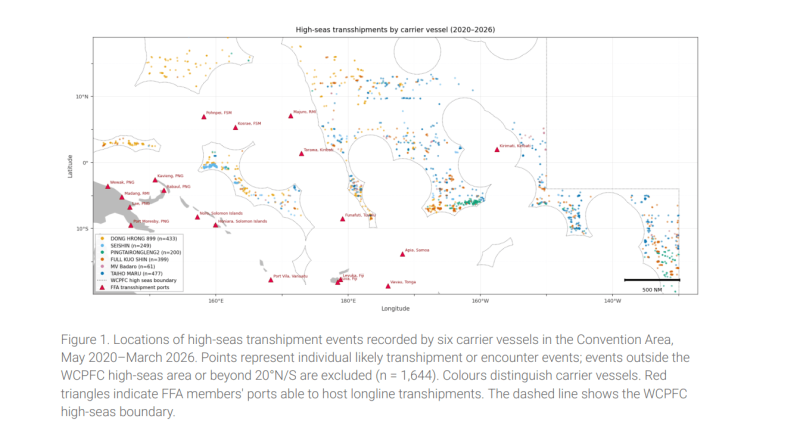
The study selected six carriers based on event volume and to cover the flag states that account for the vast majority of high-seas transshipment in the WCPFC Convention Area: Taiwan, China, South Korea, and Panama, with beneficial ownership in Japan and Chinese Taipei.
The carriers are: ‘DONG HRONG 899 (Chinese Taipei/Taiwan) ‘PINGTAIRONGLENG2’ (China), ‘SEISHIN’ and ‘MV BADARO’ (South Korea), and ‘FULL KUO SHIN’ and ‘TAIHO MARU’ (Panama).
Exemption Does Not Apply To Nearly Half Of Events
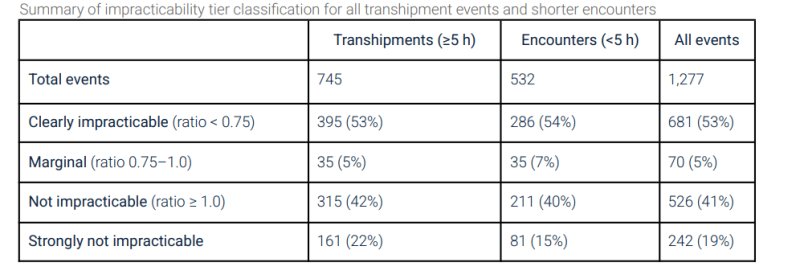
The fisheries experts who authored the paper found that out of the 1,277 transshipment events, 53 percent fell clearly under the exemption rule; that transshipment in port was impractical, while five percent was marginal. Forty-one percent did not fall under the rule.
The researchers calculated an impracticability ratio. This refers to “the distance from the geographic centre of the vessel’s fishing activity (the fishing centroid) to the transhipment location, divided by the distance to a suitable port,” they stated in the study. The port distance was measured in two ways: from the fishing centroid to the nearest suitable port, and as the vessel’s closest approach to any suitable port within two weeks of the event.
Of the 41 percent that did not fall under the WCPFC exemption rule, 242 events (19 percent of the total) have a ratio above three, meaning many tuna longliners went more than three times the distance to the port to meet the carrier at sea to transfer catches.
One of the authors of the paper, Francisco Blaha, in a blog regarding the paper, stated that the minimum step that the WCPFC can take is this – that every impracticability determination should be backed by evidence.
Atuna will publish more articles in the coming weeks about this study on where the transshipments are taking place, the cost structure of a port call for tuna vessels and carriers, and what measures that WCPFC can take to avoid at-sea transshipments that do not fall under the impracticability rule.